
Stroke in Costa del Sol and Benidorm: How to Recognize It, Why Call 112, and What the Stroke Code Is

In Spain, around 90,000 strokes occur each year, according to the Spanish Society of Neurology (SEN), and in 2025, 22,341 people died from cerebrovascular disease (INE, June 30, 2026, provisional data). But the SEN highlights two other figures. Only 50% of the population knows how to recognize the symptoms. And the Stroke Code, the rapid action protocol activated when 112 is called, is used in only about 40% of cases (SEN, October 28, 2025).
If you live in Costa del Sol or Benidorm and Spanish is not your language, it’s easy to be tempted to call your clinic, a family member, or drive the person yourself. In a stroke, each of these decisions costs minutes. One month before World Stroke Day (October 29), this guide explains how to recognize it, why the correct call is to 112, what languages are available, and what happens next.
In 30 seconds: a stroke is recognized by symptoms that appear suddenly: a crooked mouth, loss of strength on one side of the body, difficulty speaking, vision loss, imbalance, or a very severe headache. If you notice any of these, call 112, even if the symptoms disappear. This call is the way to activate the Stroke Code, the protocol that takes the patient to the most appropriate hospital. 112 provides service in English, French, and German in both Andalusia and the Valencian Community. Note the time when symptoms began and do not go to the hospital on your own.
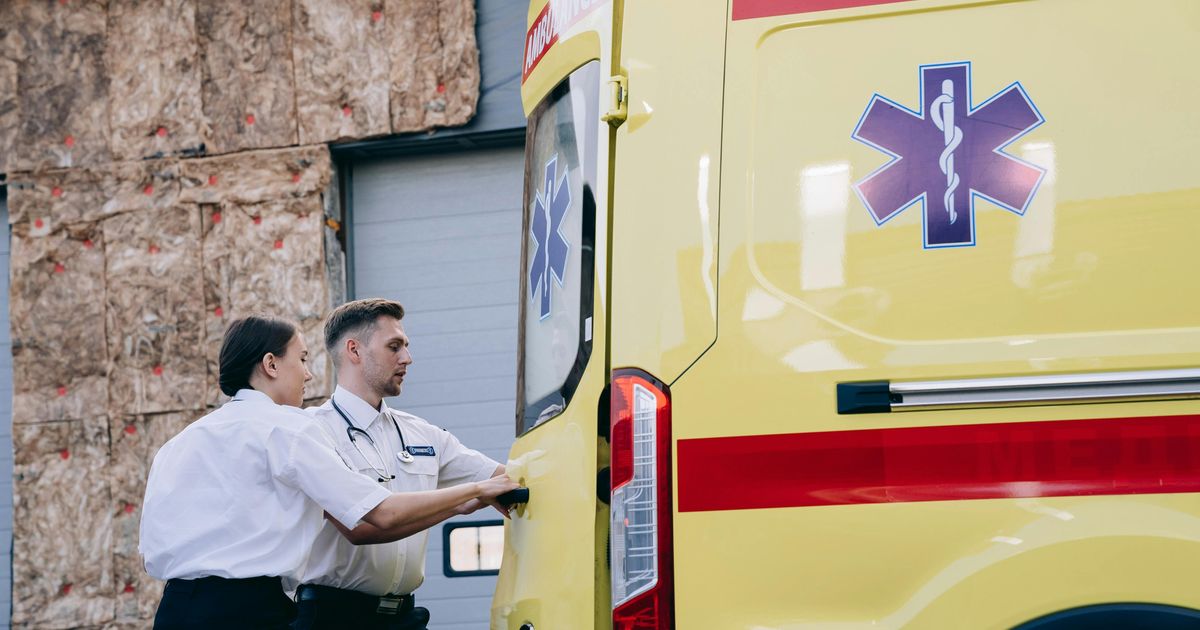
What to do in case of a possible stroke, in order
- Check face, arms, and speech: ask the person to smile, raise both arms, and answer a simple question.
- Call 112 if any of the three fail or if another warning sign suddenly appears (vision loss, imbalance, or a very severe headache), even if it passes in a few minutes.
- Note the time when symptoms began or, if you don’t know, the last time you saw the person well.
- Stay with them until the ambulance arrives, without driving them and without giving them food, drink, or medication, unless 112 instructs otherwise.
- Notify family afterward: first 112, then others.
Why every minute counts in a stroke
A stroke occurs when the blood supply to a part of the brain is suddenly interrupted or reduced. In about 8 out of 10 cases, it is because a clot blocks an artery (ischemic stroke); in the rest, because a vessel ruptures (hemorrhagic stroke), according to the SEN. The most effective treatments are time-dependent. The National Health System’s Stroke Strategy places the thrombolysis window, the drug that dissolves the clot, at the first 4.5 hours. Thrombectomy, which removes it with a catheter, is reserved for selected patients and can be performed up to 24 hours after symptom onset. The benefit, the document states, “is time-dependent” (Ministry of Health, SNS Stroke Strategy, 2024 update).
According to the SEN, acting within the first six hours reduces complications by more than 25%, and over 30% of survivors live with sequelae that cause some degree of disability or dependence (SEN).
Age is a factor. According to the SNS Strategy, the incidence of stroke doubles every five years after age 65, and in the Spanish IBERICTUS study, it peaks at age 85. It’s not just for the elderly, as up to 20% of cases occur in people under 50, according to the SEN. But if you are over 65, and especially if you live alone, this guide is for you.
How to recognize a stroke: warning signs
Stroke symptoms have something in common: they appear suddenly. The SEN lists five warning signs:
- Sudden loss of strength or sensation in the face, an arm, or a leg, especially if it affects only one side of the body.
- Sudden difficulty speaking or understanding what is being said to you.
- Sudden loss of vision in one or both eyes.
- Sudden problems with coordination or balance.
- Very intense and sudden headache, different from usual.
The Red Cross proposes three quick checks, summarized as “face, hands, speech” (Red Cross). Ask the person to smile (is their mouth crooked?), raise both arms (does one stay lower?), and answer a simple question (do they speak strangely or not understand you?). If any of the three fail, call 112. Even if they pass all three tests, also call if any of the five signs on the list suddenly appear. Do so even if the symptoms go away: the SEN insists on notifying emergencies “even if the symptoms disappear after a few minutes.”
Call 112: not a clinic, nor drive to the hospital
For those coming from another healthcare system, this part is difficult. The Stroke Code is activated when 112 is contacted (SEN): the call center assesses the case and, if a stroke is suspected, initiates the protocol. According to the SNS Strategy, its objective is for the patient to be treated “as quickly as possible in the most appropriate hospital.” If you call your doctor, private clinic, or a family member first, that clock starts later.
That includes our clinic. At Sisma, we attend to emergencies 24 hours a day, but if a stroke is suspected, the correct action is to call 112. The Andalusian campaign summarizes it in three words: “Time is brain.” It also points out three mistakes to avoid: waiting to see if symptoms pass, not telling anyone, and driving to the hospital (Junta de Andalucía, Andalusian Stroke Care Plan). The order is always the same: first 112, then family.
In Andalusia, 061, the emergency health center of the Andalusian Health Service, also operates (Junta de Andalucía, July 2026). But the phone number with proven service in English, French, and German is 112: if you don’t speak Spanish well, use 112.
If it happens to you and you are alone
Call 112 immediately, without waiting to see if it passes, and say that you are alone. Do not drive. If you can do so without risk of falling, open the house door; if not, stay where you are and tell 112 if a neighbor has a key. Keeping your phone with you, and not charging in another room, makes a difference in these cases.
112 serves you in English, French, and German
112 Andalusia provides service in English, French, German, Arabic, and Ukrainian, in addition to Spanish. In 2024, it answered 43,845 calls in other languages, three out of four in English (Junta de Andalucía, April 16, 2025).
In the Valencian Community, 112 provides service in Valencian, Spanish, English, French, and German. In 2023, it managed 21,560 calls in English, French, and German, 17,064 of them in English (Generalitat Valenciana, January 24, 2024).
If you speak Finnish, Swedish, Dutch, or another language not on these lists, ask to be served in English. Have the phrase “I think it’s a stroke” and your address written down next to the phone in Spanish, and don’t wait to find someone to translate before calling.
What to say when you call
Perfect Spanish is not necessary. With these phrases, the call will progress:
| Purpose | What to say in Spanish |
|---|---|
| Request your language | “¿Puede atenderme en inglés / francés / alemán?” (Can you help me in English / French / German?) |
| State what’s happening | “Creo que es un ictus.” (I think it’s a stroke.) |
| State when it started | “Empezó a las… / Lo (la) vi bien por última vez a las…” (It started at… / I last saw him/her well at…) |
| Give the address | “Estoy en la calle… (o urbanización…), número…, piso…, en Fuengirola / Benidorm.” (I am on street… (or urbanization…), number…, floor…, in Fuengirola / Benidorm.) |
| Report medication | “Toma (o tomo) anticoagulantes.” (He/she takes (or I take) anticoagulants.) |
What the Stroke Code is and how it works in Malaga and Alicante
The Stroke Code is the protocol that coordinates the emergency center, the ambulance, and the hospital so that the patient arrives as soon as possible at the facility capable of treating them. You do not choose the hospital, nor does the ambulance team on their own: professionals decide following the protocol.
In Andalusia, about 21,000 strokes occur annually. The Andalusian Telestroke Center (CATI) has activated the Stroke Code on 6,793 occasions since 2019, 922 of them in the province of Malaga (Junta de Andalucía, December 25, 2024). It operates as a network: if the patient arrives at a regional hospital, a vascular neurologist assesses them remotely via video call and reviews their test images. In the province of Malaga, telestroke serves the hospitals of Antequera, Ronda, and La Axarquía, and the Costa del Sol Hospital in Marbella (Junta de Andalucía, August 2024).
In the Valencian Community, the Stroke Code was activated 1,578 times between January 1 and October 24, 2024, 504 of them in the province of Alicante. The most frequent profile was a man between 70 and 89 years old (Generalitat Valenciana, October 29, 2024). In 2025, its emergency coordination centers received 14,705 alerts for possible strokes (Generalitat Valenciana, March 16, 2026).
| Costa del Sol (Malaga) | Benidorm (Alicante) | |
|---|---|---|
| Phone with service in other languages | 112 | 112 |
| 112 Languages | Spanish, English, French, German, Arabic, and Ukrainian | Valencian, Spanish, English, French, and German |
| Protocol | Stroke Code, with the support of the Andalusian Telestroke Center | Stroke Code, coordinated by emergency centers |
| Published figures | 6,793 Stroke Code activations by CATI (2019-December 2024), 922 in Malaga | 1,578 activations (January-October 2024), 504 in Alicante |
The periods and scopes of the two columns are different, so the figures are not comparable.
While waiting for the ambulance: what to do and what not to do
The waiting minutes also count. This is what the Junta de Andalucía, the Valencian Society of Neurology, and the Red Cross recommend:
| Do this | Avoid this |
|---|---|
| Note the time symptoms began or, if you don’t know, the last time you saw the person well | Waiting to see if it passes |
| Stay with the person and follow 112’s instructions | Driving them to the hospital |
| If they lose consciousness but are breathing, place them on their side, in the recovery position | Giving them food, drink, or medication (not even aspirin), unless 112 instructs otherwise |
| Have their documents, health card or insurance, and medication list handy | Calling the family doctor to come later |
| Open the house door or ask a neighbor to wait for the ambulance at the entrance | Leaving them alone |
Time matters because treatments have a window. When no one knows when the stroke started, the Stroke Code protocol of the Dr. Balmis University General Hospital in Alicante takes “the last time seen without symptoms” as the onset time (Alicante Health Department, November 2024). For those who live alone, this is another reason to arrange a daily call at a fixed time with a family member or neighbor.
What you can do beforehand: risk factors
The best call to 112 is the one that isn’t necessary. The SNS Stroke Strategy estimates that between 80% and 90% of strokes are preventable by controlling risk factors such as high blood pressure, diabetes, smoking, or obesity (Ministry of Health). This prevention starts in the consultation room, not in the emergency room.
There is one factor that deserves its own paragraph because it often goes unnoticed: atrial fibrillation, a heart arrhythmia. According to the same Strategy, 5% of people over 70 have it and it causes almost a quarter of strokes in those over 80. Furthermore, “the arrhythmia is usually silent or episodic.” If you notice an irregular pulse or palpitations, discuss it with your doctor. They will assess if you need anticoagulant treatment, a treatment that should never be started or stopped on your own.
If you spend long periods here, take the opportunity to get your blood pressure, pulse, and blood tests checked, and always carry an updated list of your medication with the active ingredient. If you also come for the winter, review what to do with your prescriptions in Spain.
After the hospital: rehabilitation, returning home or to your country
For a foreign resident, discharge after a stroke raises practical questions. Who will care for you at home? How will you continue with rehabilitation? Is it advisable to return to your country and how will you make the journey? Some guidelines save a lot of problems:
- Before discharge, ask how rehabilitation will continue (physiotherapy, speech therapy) and who coordinates it.
- Request the full discharge report and a copy of the imaging tests. Any doctor who treats you afterward, here or in your country, will need them.
- Review new medication with a doctor before the first prescription runs out.
- Organize follow-up home visits if mobility is an issue: a home doctor can monitor blood pressure, medication, and progress.
- If you are returning to your country, plan the trip with the medical team. Depending on the patient’s condition, a national or international medical transfer may be necessary, with a medical report and, sometimes, accompaniment.
- Consult your insurer about what is covered and what steps are required before organizing any transfer.
How we can help you
In case of a stroke, call 112, even if you don’t speak Spanish. For everything else, we are nearby. At our medical centers in Fuengirola, Torremolinos, Benidorm, Torrox, and Almuñécar, or at your home with a home doctor, we monitor blood pressure, pulse, and medication, in Spanish, English, German, French, and Finnish. After hospitalization, we organize ambulance transfers and help you with documentation for your international insurance.
👉 Request a blood pressure, pulse, and medication check or call us at +34 624 62 86 00 (inquiries and appointments; does not replace 112). If you are interested in the topic, here we explain what other urgent symptoms you should not ignore and why language is a vital sign in an emergency.
Informational content prepared by Servicios Sanitarios Sisma and updated on September 27, 2026. Sources: SNS Stroke Strategy, Spanish Society of Neurology, INE, Junta de Andalucía, Generalitat Valenciana, Alicante Health Department, Valencian Society of Neurology, and Red Cross. Does not replace the assessment of a healthcare professional. If a stroke is suspected, call 112.
Frequently Asked Questions about Stroke
What are the symptoms of a stroke?
According to the SEN, there are five warning signs. Sudden loss of strength or sensation in the face, an arm, or a leg, especially on one side. Sudden difficulty speaking or understanding. Sudden vision loss. Sudden problems with coordination or balance. And a very intense and unusual headache. What characterizes them is that they appear suddenly.
Should I call 112 even if the symptoms have passed?
Yes. The Spanish Society of Neurology recommends calling emergencies immediately, even if the symptoms disappear after a few minutes.
Does 112 provide service in English, German, or French?
Yes. 112 Andalusia provides service in English, French, German, Arabic, and Ukrainian, in addition to Spanish, and 112 of the Valencian Community in Valencian, Spanish, English, French, and German. Finnish is not on these lists: if it is your language, ask to be served in English.
What is the Stroke Code?
It is the rapid action protocol activated when 112 is called: the call center assesses the case and, if a stroke is suspected, coordinates the ambulance and the hospital so that the patient arrives as soon as possible at the center prepared to treat it. According to the SEN (October 2025), it is used in only about 40% of cases.
Can I drive the person to the hospital myself?
No. Call 112: it is the way to activate the Stroke Code from the very beginning, and the protocol decides which hospital is most appropriate. The Junta de Andalucía includes “driving to the hospital” among the mistakes to avoid.
What should I do if I don’t know when the symptoms started?
Tell 112 and indicate the last time you saw the person well. The Stroke Code protocol of the Dr. Balmis University General Hospital in Alicante takes that time, the last time seen without symptoms, as the onset time.
