
Older parents living alone on the Costa del Sol or in Benidorm: a guide for children living abroad

In Spain, 2,131,400 people aged 65 or over were living alone in 2020, and 70.9% were women (INE, April 7, 2021). Living alone is not a problem in itself, but it does carry risks worth understanding. One is unwanted loneliness: among the adult population it is twice as common among those who live alone (34.5%) and almost twice as common among people of foreign origin as among those of Spanish origin, according to the Unwanted Loneliness Barometer (SoledadES, press release of June 10, 2024).
This guide is for you if you live in the United Kingdom, Germany, the Netherlands, France or Finland and your father or mother, aged over 65, lives alone on the Costa del Sol or in Benidorm. We say “your mother” because most older people living alone in Spain are women, but everything applies equally to your father. If you are visiting her at Christmas, use the trip to check how she is doing, talk calmly, and leave a few things organised.
In 30 seconds: during your Christmas visit, check her weight, food, hygiene, medication, how cold the home is, and how she moves around. Ask whether she authorises her doctors to share information with you. Before you leave, write down her medication and key phone numbers, find a neighbour with a spare key, and consider public telecare. In an emergency, 112 must be called by someone in Spain. If she is admitted to hospital, request the discharge report and a plan for the following days.
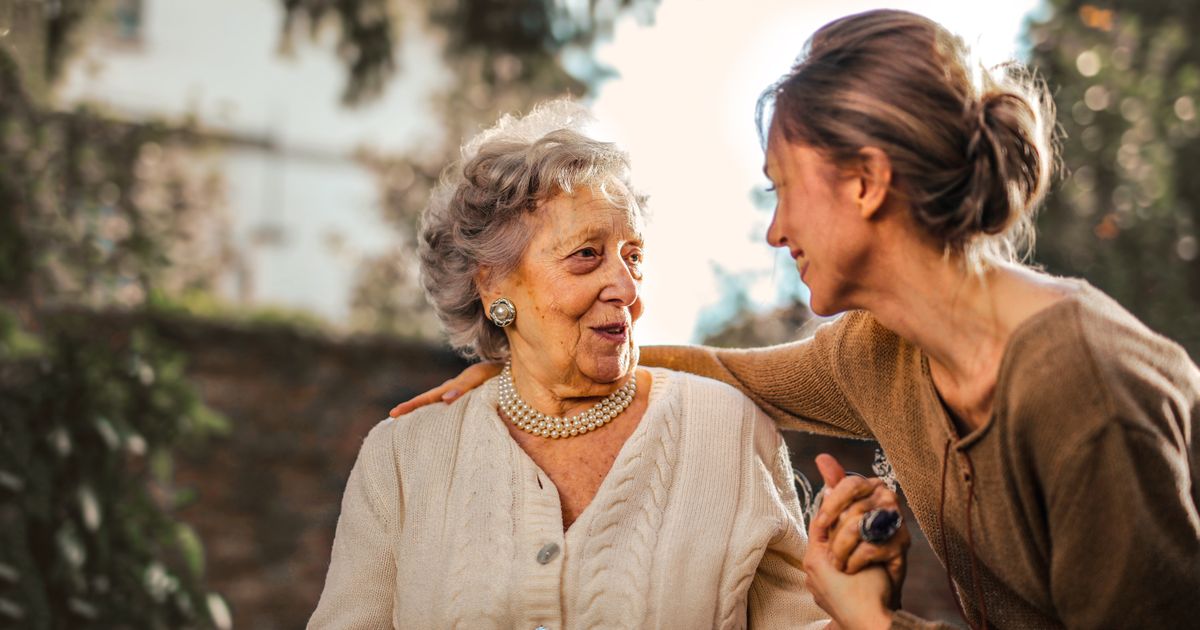
What to look for during your Christmas visit
Málaga Airport ended December 2025 with 1,681,268 passengers, its best December on record (Aena, January 13, 2026). If you are also travelling to see your mother, pay attention to how she is doing—without turning the visit into an inspection.
The signs in the table below come from two UK organisations for older people, Age Scotland (January 8, 2026) and Age UK (November 3, 2026), as well as NHS pages and Spain’s Ministry of Health. Focus above all on what has changed since your last visit.
| What you see | Why it matters | What you can do |
|---|---|---|
| She has lost weight or her clothes are loose | Unintentional loss of 5% to 10% of body weight over 3 to 6 months is one of the main signs of malnutrition, and people over 65 are at higher risk (NHS, May 2023) | Discuss it with her doctor |
| The fridge or pantry is suddenly empty | A warning sign for Age Scotland | Ask how she does the shopping and look for support together |
| She is neglecting her appearance or hygiene | A warning sign for Age Scotland and Age UK | Ask how she is doing, without reproaches |
| Missed doses or boxes of medication piling up | A warning sign for Age UK | Make a list together and review it with her doctor or at the pharmacy |
| The house is cold | Older people living alone are at higher risk of hypothermia (NHS, June 2023) | Check the heating and make sure she has blankets and warm clothes within reach |
| She leans on furniture when walking or has already fallen | Nearly 30% of people over 65 living at home fall at least once a year (Ministry of Health, 2026) | Suggest removing loose rugs and improving night lighting, and discuss it with her doctor |
None of this is a diagnosis: a single sign can have many explanations. If something worries you, talk to her first and, if she agrees, to her doctor. On falls, in our guide for older people living alone we explain how to prevent them and what to do if one happens.
How to talk about it with her without deciding for her
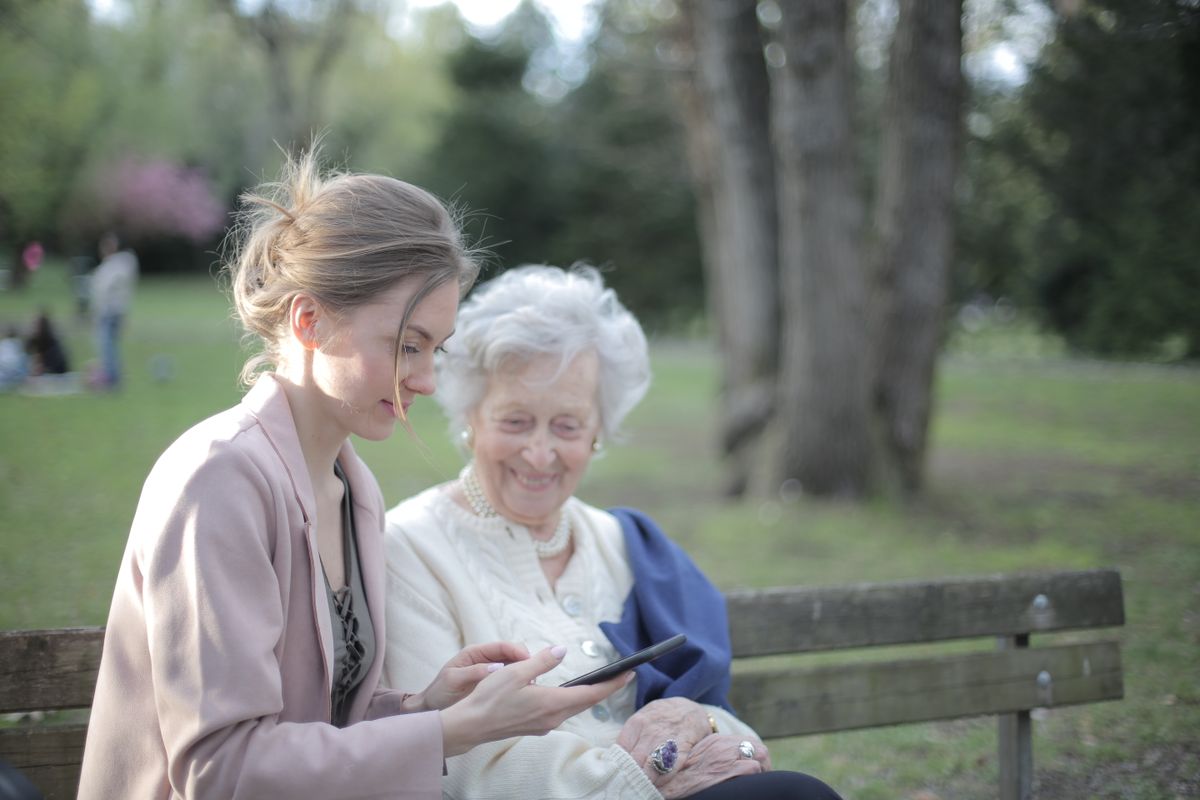
Your mother is an adult and decides how she wants to live, even if she would not choose what you would choose. Speak with her, not for her—also in front of her doctor. Start with questions: “How are you managing with the shopping?” or “Who would you call if you felt unwell at night?”. Then agree on small steps, such as a daily call or having a neighbour keep a key.
It is worth asking her now—not in a hospital corridor—whether she wants her doctors to share information with you. Law 41/2002, on patient autonomy, states that the holder of the right to information is the patient. People linked to the patient for family reasons or in practice will also be informed “to the extent that the patient expressly or tacitly allows it” (art. 5).
If your mother agrees, the clearest option is for her to say so explicitly: to her GP and, if she is ever admitted, to the team treating her. Ask at her health centre or insurer how to record your name and phone number.
If, in the doctor’s judgement, she cannot understand the information due to her physical or mental state, the law provides that people linked to her for family reasons or in practice are informed (art. 5.3). And if your mother prefers that you are not informed, that is her decision: explain what worries you and respect her answer.
Before you head back home: what to have organised
Having this ready during your visit saves you blind calls when you are far away:
- A list of her medication with the active ingredient, dose and schedule—on paper by the phone and on your mobile. If she spends the winter here on treatment from her home country, review what to do with prescriptions and medicines in Spain.
- Her healthcare cover: health card, S1, or private insurance policy. Take a photo of each document and note the insurer’s assistance number.
- Her health centre and doctor: name, address and phone number.
- A trusted neighbour or friend with a house key, who has your phone number and whom you can call. They will be your local contact if something happens.
- Key numbers by the landline: 112, the health centre, the insurer, the neighbour and yours. Add her full address in Spanish, to read out if she calls 112.
- A daily call at a fixed time, with you or another family member. If she does not answer one day, you already know who to alert to go and check on her.
- Her mobile charged and always on her, even at home.
Public telecare in Andalusia and Benidorm
Telecare lets you request help from home via a monitoring centre. In Andalusia, if there is an emergency, the public service notifies family members (Junta de Andalucía, Andalusian Telecare Service leaflet, 2022). Requirements depend on where your mother lives:
| Costa del Sol (Andalusia) | Benidorm (Alicante) | |
|---|---|---|
| Who can apply | From age 65, the only requirement is having the Tarjeta Andalucía Junta 65 (aged 65+ and resident in Andalusia) | Over 70, registered as resident in Benidorm for at least one year, living alone (or with people in a similar situation) and with income below a limit |
| Cost | Ask when you apply | Free of charge, under the 2021 municipal regulations |
| Phone | 900 920 029 | 966 815 466 |
Requirements according to the Andalusian Agency for Social Services and Dependency, those for the Tarjeta Andalucía Junta 65, and the Benidorm municipal regulations of June 2021. Confirm current conditions before applying, especially in Benidorm. If your mother lives in another municipality in Alicante, ask at the town hall.
If something happens and you are far away
If you dial 112 from another country, Spain’s 112 will not answer. In the European Union, the call is handled by the 112 centre in the country you are in at that moment, as explained by Estonia’s official emergency service (Estonia 112). That is why, from abroad, what helps most is a local contact: a neighbour, friend or family member in Spain who can call 112 or go to the house.
112 Andalusia answers in Spanish, English, French, German, Arabic and Ukrainian (Junta de Andalucía, Governing Council, April 16, 2025), and the Valencian Community service answers in Valencian, Spanish, English, French and German (Generalitat Valenciana, January 24, 2024). If her language is not on those lists, she should ask to be assisted in English if she speaks it, or have a neighbour call.
If you are in the United Kingdom, the UK Foreign, Commonwealth & Development Office (FCDO) provides a 24-hour number in London for anyone who needs urgent help because something has happened to a family member or friend abroad: 020 7008 5000 (GOV.UK, Spain: getting help). If you live in another country, look up your foreign ministry’s consular assistance number and save it on your phone.
| Situation | What to do |
|---|---|
| Life-threatening emergency: she is unresponsive, struggling to breathe, has stroke symptoms, or has had a severe blow to the head | Whoever is with her should call 112. If you find out from abroad, alert your local contact to call 112. |
| She does not answer the usual call | Ask your local contact to go and check on her. If she does not open the door or is found unwell, they should call 112. |
| She has hit her head and takes anticoagulants | She needs assessment at hospital even if she feels fine. If she cannot get there on her own or you are unsure, call 112. |
| Something that does not seem serious: mild fever with no other symptoms, feeling unwell, or a fall after which she got up on her own, with no severe pain and no blow to the head | A home-visiting doctor or an appointment at a medical centre—always with her consent. If she worsens or you are unsure, call 112. |
A private doctor does not replace 112—neither do we. In a life-threatening emergency, the first call is always 112.
If she is admitted to a Spanish hospital
First comes information—and it depends on what your mother authorises (art. 5 of Law 41/2002). If she is conscious, the fastest way is for her to tell the team herself that they may inform you. Ask on the ward how and when they update family members, and leave your name and phone number.
Then, language. In Andalusia, Salud Responde (955 54 50 60), from the Andalusian Health Service, offers a translation service in 39 languages (SAS, June 20, 2025). In the Valencian Community, ask the hospital what language support they provide.
If your mother is British, the consulate can help with some things, but not everything. GOV.UK’s guide for people in hospital abroad explains that it can notify family and help with communication, while clarifying that “this is not a formal translation service”. However, it does not pay hospital bills, does not pay for the return home, and cannot secure discharge (GOV.UK, In hospital abroad, June 7, 2024).
Also check what her insurance covers: if she has private or travel insurance, call the insurer as soon as possible and ask what steps are required. And if someone can bring her things from home, she will usually need her ID and health card, S1 or policy, the medication list, glasses, hearing aids or dentures, her mobile charger, and comfortable clothes.
Discharge: what to request before leaving
At the end of a hospital stay, your mother—and, where applicable, a family member or a person linked to her—has the right to receive a discharge report (art. 20 of Law 41/2002). In public healthcare, Royal Decree 1093/2010 sets the minimum dataset for that report, which includes, among other items, the reason for admission, discharge treatment and the care plan. It will be useful for any doctor who treats her afterwards, here or in her home country.
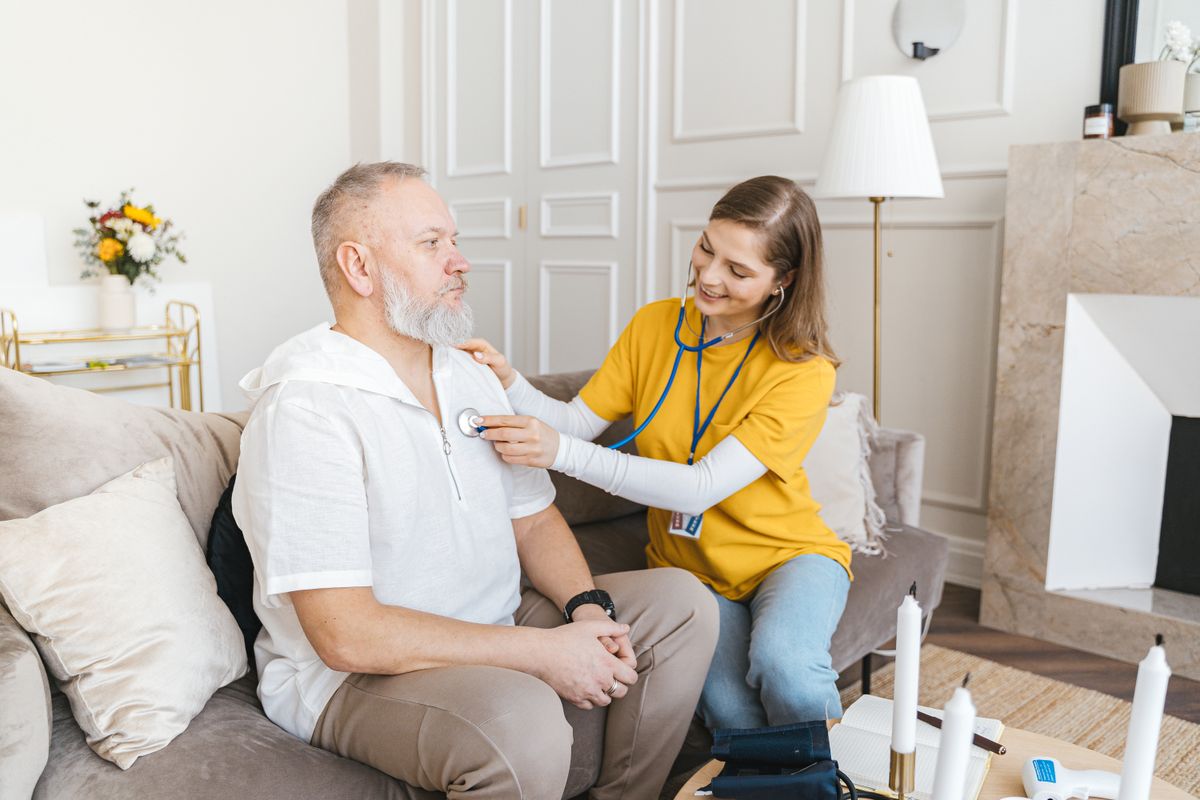
Before leaving, go over these points with the team and with her:
- The discharge report, with a copy for you if she agrees.
- New medication: what has changed, what she should stop taking, and for how long. Update the home list and review the treatment with her doctor before the first prescription runs out.
- Who will look after her for the first few days. If she lives alone, think about who can check in on her, do the shopping, or accompany her to appointments.
- Follow-up: when the next review is and with whom. If she struggles to get around, a home-visiting doctor can review at home how she is progressing and what medication she is taking.
- Getting home or back to her country: ask whether she needs an ambulance transfer. If she wants to return to her country, plan the trip with the medical team and check in advance what her insurance covers; in our guide to international medical transfers we explain requirements, costs and insurance.
Documents best prepared calmly
These two documents are best prepared at home, with time, rather than in hospital.
Advance directives or advance healthcare decision
With this document, an adult sets out in writing their wishes regarding healthcare and treatment, to be followed if they reach a situation in which they cannot express them (art. 11 of the Law 41/2002). In Andalusia it is called a declaration of advance healthcare decision (declaración de voluntad vital anticipada). It is registered with an in-person appointment, requested via Salud Responde (955 54 50 60), and is valid throughout Spain (Junta de Andalucía). In the Valencian Community, the Generalitat provides an official form, and the document is also registered in the National Registry of Advance Directives (Generalitat Valenciana, 2023 form). If she is unsure what to include, she can discuss it with her doctor.
Preventive power of attorney
Preventive powers of attorney are currently regulated by articles 256 to 262 of the Civil Code, as amended by Law 8/2021. They allow a person to grant authority to someone they trust, with a clause so that “the power remains in force if in the future they require support in exercising their legal capacity” (art. 256). They must be granted by public deed, i.e., before a notary (art. 260). To know whether it is appropriate and how to prepare it, the right step is to consult a notary or a lawyer.
How we help
In a life-threatening emergency, call 112—or ask someone in Spain to do it. For anything that is not a life-threatening emergency, we are close to your mother. At our medical centres in Fuengirola, Torremolinos, Benidorm, Torrox and Almuñécar—or at her home with a home-visiting doctor—we review her medication and assess how she is doing, always with her consent. You can speak with us in Spanish, English, German, French or Finnish; to provide you with medical information about her, we need her authorisation. After a hospital stay, we arrange ambulance transfers and help you with international insurance documentation.
👉 Request an appointment or a home visit or call us on +34 624 62 86 00 (enquiries and appointments; does not replace 112).
Informational content prepared by Servicios Sanitarios Sisma and updated on November 12, 2026. Sources: INE, SoledadES, Aena, Ministry of Health, Age Scotland, Age UK, NHS, Junta de Andalucía, Andalusian Health Service, Benidorm City Council, Generalitat Valenciana, Estonia 112 service, GOV.UK, Law 41/2002, Royal Decree 1093/2010 and Law 8/2021. It does not replace advice from a healthcare or legal professional. In an emergency, call 112.
Frequently asked questions for children living abroad
Will they give me medical information about my mother or father if I live outside Spain?
It depends on what your family member authorises. Under Law 41/2002 (art. 5), the holder of the right to information is the patient, and family members are informed to the extent that the patient allows it, expressly or tacitly. The most practical option is for your family member to tell the team they may inform you, and for you to leave your name and phone number on the ward.
Can I call 112 from the UK or Germany to request help in Spain?
That is not the way. If you dial 112 from another country, you reach that country’s emergency centre, not Spain’s. What helps is having a contact in Spain—such as a neighbour or friend—who can call 112 or go to the house. If you are in the UK, the FCDO answers on 020 7008 5000 24/7.
Who can apply for public telecare in Andalusia?
From age 65, the only requirement is having the Tarjeta Andalucía Junta 65, which can be requested by anyone aged 65+ who resides in Andalusia, according to the Agency for Social Services and Dependency. The phone number is 900 920 029 and, in an emergency, the service notifies family members. Confirm the cost and conditions when you apply.
What should the discharge report include?
In public healthcare, Royal Decree 1093/2010 sets the minimum dataset, which includes, among other items, the reason for admission, discharge treatment and the care plan. Law 41/2002 (art. 20) recognises the right to receive it for the patient and, where applicable, a family member or a person linked to them. Request it before leaving the hospital.
Does the British consulate pay for the hospital or the trip home?
No. According to GOV.UK, the consulate can notify family and help with communication, although it is not a formal translation service. It does not pay hospital bills or the return home, and it cannot secure discharge. That is why it is worth knowing what your family member’s health card, S1 or insurance covers.
What is a preventive power of attorney?
It is a power of attorney granted to someone trusted, with a clause so it remains in force if, in the future, the person needs support in exercising their legal capacity. It is regulated by articles 256 to 262 of the Civil Code, as amended by Law 8/2021, and must be granted by public deed, before a notary. To know whether it is appropriate, consult a notary or a lawyer.
